
Particularly during the early days at nursery or after-school care, it is important for everyone involved – both parents as well as the team – to align their educational and upbringing approaches with the children’s needs and to establish a reliable rapport despite any potential friction or uncertainties.
It is about taking a shared view of the child – with the child’s best interests in mind. And this requires adults who can cultivate a respectful relationship.
Two worlds – one child
When children start nursery, they enter a whole new world – a world with different routines, different expectations and different relationships.
For children, this is a major step in their development. For parents too. After all, every day they entrust their child to people with whom they are not yet familiar. And all this at a stage when children are usually not yet able to talk about their experiences. They are often unable to make sense of what they have experienced, let alone put it into words. As a result, there are many things parents cannot find out from their child, such as how their child is being treated when they are not present. “What made my child happy today? What was perhaps a bit of a struggle? Were there any moments where they felt uncertain? Did they allow themselves to be consoled if they were feeling sad?“
This means: parents rely on receiving such information from the very people to whom they have entrusted their child, and on being able to trust them. This also applies to schoolchildren at after-school care.

Sometimes, this vitally important trust is there right from the start. As a general rule, it is built gradually, starting with the initial meeting, through the settling-in period at nursery or the after-school care centre, and continuing as the relationship develops over the days, weeks, months and years that the child attends nursery or after-school care.
The child lives in these two very different worlds; for those attending after-school care, it is actually three worlds along with school. Parents and teaching professionals do not experience this situation. The child reacts to their experiences in these very different worlds and needs the adults in these different worlds to show understanding and offer support in response to their reactions and in order to meet their needs.
This understanding is especially important when children transition from nursery to school and also attend after-school care. Two worlds become three. What began with a gentle start at nursery is now associated with new demands placed on the child’s autonomy. Whilst at school the established structure and shared space with peers usually create a safe environment, the introduction to after-school care can be a challenge when age groups are then mixed and children from different classes, each with their own experiences, come together. The social interaction can also be strained by conflicts between the children, which are monitored and supported by the after-school care staff. Educational partnership is expanding, which also means more communication and information for parents. What does the child experience, how do they behave and what do they need in what are now three worlds?
To gain an insight into these other worlds, adults build bridges between them that are based on respect, the exchange of information and open communication.
Mutual respect and open communication
These bridges are made especially stable by empathy and an understanding of each other’s worlds. For many parents, their child starting nursery is a time of mixed feelings. Alongside joy and a sense of relief, there is often uncertainty and a host of questions. This is precisely because any insight into this other world of the child is limited.
Which is why the way nurseries and after-school care centres treat parents is so important.
They need to feel that: I am welcome here. Here, my questions, suggestions and also my concerns are taken seriously.
In the day-to-day nursery routine, this brief exchange occurs when dropping off and picking up children. Parents inform the staff: What is important to know? Have there been any unusual incidents? Or even: How was the night and the morning? How is the child’s mood as they arrive at the nursery? The staff, in turn, let parents know what made their child happy or upset that day. How they are doing now. Whether they let themselves be consoled when sad or irritated. These brief snippets of information here and there have a big impact. They open the doors to these other worlds and lay the groundwork for how educational partnership can be put into practice in the face of irritation, uncertainty or conflict. This helps to build trust and a sense of security, allowing parents to feel comfortable „handing over“ their child.
At after-school care, these conversations often revolve around friendships within the group or arguments and conflicts the child has experienced during the afternoon.
In the event of a conflict between adults, on the other hand, a foundation of this kind helps them to listen to one another, acknowledge each other’s concerns and seek solutions together. The child and their needs are always the main focus.
So what are the kinds of issues that can cause irritation or concern and lead to conflict?
Understanding different living environments
Nursery is an intense place for children. Lots of children, lots of stimuli, lots of social situations. This places a high demand on children.
It is not unusual, therefore, for children to act differently at nursery than they do at home. A child who seems well-adjusted at home may find nursery quite overwhelming. A child who rarely requires rest at home may suddenly feel exhausted when in a group. A child who cooperates at nursery may become more clingy and get into conflicts more often at home. A child who is able to do many things independently at nursery may want more support and attention at home.
Schoolchildren, too, behave differently at home than they do at school and at after-school care.
These differences are not a sign that „something is wrong“. They simply show how different these environments are and how the child adapts to them. What is needed here is mutual understanding and an appreciation of just how exhausting this process of adaptation is for the child.
The child’s exertion is evident, for example, in a common conflict situation that occurs between these two worlds: Parents would prefer their nursery-school child not to have a midday nap, as they no longer need this sleep at home and the parents are worried that their child might then fall asleep too late in the evening (which may well be the case if the sleep pressure is not high enough in the evening). At nursery, there’s an incredible amount of stimuli – it is nothing like everyday life at home. As well as having to adapt to all the demands in general, it is this sensory overload that exhausts children, causing them to fall asleep even in the middle of playing if they have not had their afternoon nap.
Schoolchildren may not always want to talk about what they have experienced straight away; they may need a little more time. In this case, mutual understanding means recognising that for the nursery-school child: „At home, a nap is no longer required. At nursery, it’s still necessary for a little while“, even if this means that their evening sleep might start much later. Fortunately, transition periods like these do not generally last too long.
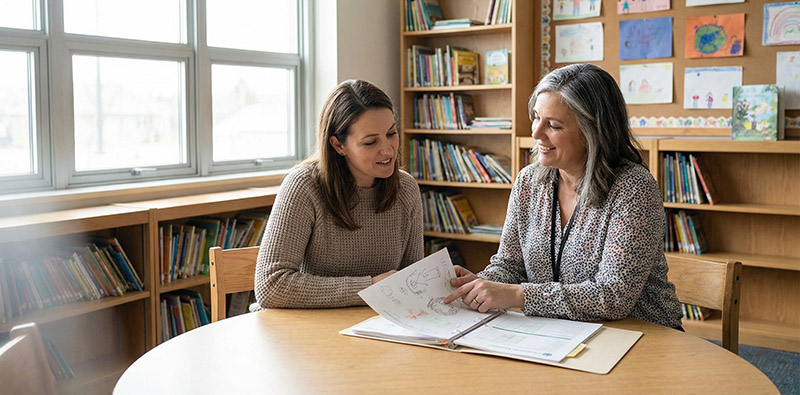
Keep the lines of communication open – especially when worries arise
The strength of this cooperation becomes particularly apparent when uncertainties or concerns arise. And they will crop up time and again in everyday life.
Challenging behaviour amongst children can cause parents and professionals considerable concern in some cases. At nursery, children hit, push, shout, cry, take things from others or break things, and bite. This is all part of everyday life for very young children who disagree, who feel someone has got too close, who are fighting over something they want or who simply want to play with others. Socially acceptable behaviour must first be learnt and reinforced, and nursery is a wonderful place to do so.
A situation where parents are separated, for example, can lead to unusual or challenging behaviour in a child at nursery and after-school care.
Naturally, it is worrying for parents if their child has been pushed, hit or even bitten at nursery. How can that happen? Who was not paying attention? What is wrong with the child who bit them? In schoolchildren, rude or careless behaviour that appears to be out of the blue can be unsettling: „What’s going on here?“. These are questions that parents ask themselves straight away. The professionals, for their part, are concerned and wonder what might be behind a child displaying increasingly challenging behaviour.
For the children concerned, it is important that adults engage with them in such situations in a manner that is positive and as open-minded as possible, exchange their various perspectives, try to understand, ask questions and thus seek solutions together.
For parents, it is important to feel that their concerns are taken seriously. This is particularly true if their child has been bitten or excluded; the concern grows, and with it, often anger too, if it happens repeatedly.
Biting amongst children is one of the major challenges in day-to-day life at nursery. Although biting is a normal part of development up to the age of about three and does not indicate any disorder, it nevertheless causes a great deal of stress for everyone involved, since children can be injured. Sometimes to such an extent that the wound requires medical treatment. For schoolchildren, it may be bullying situations that cause distress.
Situations like this understandably cause parents a great deal of anxiety. How can parents and professionals remain in constructive dialogue in these cases so that behaviours such as these can be overcome together? What is needed is:
- professionals who clearly inform both the parents of the child who bit or bullied another and the parents of the child who was bitten or bullied – either immediately after the incident or when they come to pick up their child – about what happened and how the situation was handled,
- understanding for the concerns of all parents,
- no assignment of blame,
- awareness of the background of the biting or bullying,
- confidence that the nursery and after-school care centre are doing their utmost to resolve this issue, such as keeping a closer eye on both children and adopting a coordinated approach.
Seek direct conversation if you notice anything at home
Educational partnership thrives when not only the nursery or after-school care centre but also the parents contribute their perspectives.
Parents notify staff if there are any changes in a child’s life – a new family situation, an upheaval, a source of stress or even something positive that is at the front of the child’s mind. It is helpful for professionals to be aware of this so that they can better contextualise the child’s behaviour.
Sometimes conflicts between children happen out of sight; even biting can go unnoticed, meaning that it is not spotted at nursery.
If parents notice anything at home, if their child mentions something or if there is any other cause for concern or questions, it is important that parents take the direct approach and seek a conversation with the staff at the centre. Often, questions are quickly resolved and concerns dispelled – or at the very least taken seriously, which helps to ease them.
Child protection as a shared responsibility – including at after-school care
For the professionals, on the other hand, it is important to actively reach out to parents if they notice any changes, if the child confides in them or if there are any other reasons for concern. This is necessary at after-school care too.
Aggressive behaviour towards other children at after-school care requires ensuring parents are at the same level in order to understand any potential stressors and reasons behind this behaviour, and to agree on a coordinated approach as to what next steps would be helpful.
If a child behaves differently from usual, e.g. if they find themselves involved in more conflicts or become particularly withdrawn, this leads to another essential area of collaboration: child protection.
The specialist framework for this is provided by child protection policies for nurseries and after-school care centres in Vienna. These are enshrined in law; in other words, they are formal guidelines, but not just that. They are also reflected in everyday life. On the one hand, they set out how children are protected within the institution – through clear structures, a code of conduct for all employees and a conscious approach to issues of closeness, distance and power. Children should feel safe – both physically and emotionally.
Child protection is not just about acting with care within the institution. It also means keeping an eye out for any changes in a child that may be cause for increased concern. If professionals notice that a child is behaving unusually, appears to be under high levels of stress or confides in them, they are obliged to look into the matter. This is not done hastily, but with care and in accordance with a coordinated procedure. And this is where educational partnership comes into play on a special level – as a joint effort to always look out for the child’s best interests. What could be behind this? What does the child need right now?
Parenting together whilst apart, remaining partners in our children’s education
When parents separate, it is challenging for everyone involved. Alongside the personal aspects such as hurt feelings and worries, and the necessary practical arrangements surrounding this separation, it is a particular challenge to continue to be parents for the shared child. Mutual respect, a minimum level of trust and a willingness to communicate and cooperate form an important foundation when it comes to making this co-parenting a reality. And this foundation is also needed to ensure that separated parents can become and remain partners in education with nurseries and after-school care centres. It is important to coordinate effectively and provide timely information on who is picking up the child and when, what the child’s daily routine is like at both places, what the parents need to know about each other and what the nursery and after-school care centre need to know. This enables the team to support the child in a way that is appropriate to the situation and to create a reliable framework.
The situation becomes especially difficult if the separation is contentious and the conflicts extend beyond the separation itself or only arise afterwards, when information is withheld and agreements are not honoured, the child is torn between the two sides and staff at the nursery and after-school care centre are also drawn into the conflict. This kind of situation places an immense psychological strain on the child and simultaneously makes it more difficult for the teams to create a safe space for the child.
Boundaries, expectations and responsibility
One area that often presents challenges in cooperation is the issue of boundaries. Clear guidelines are in place at nursery and after-school care. Rules, routines and structures provide guidance for many children at once. These rules help to organise everyday life. They can be irritating for parents, especially if they guide their child in a different way at home. For example, if a child is not allowed to bring certain items to nursery or is expected to follow routines that are different from those at home, this can raise questions. At the same time, it is precisely in groups that children need this clarity. It helps them to find their bearings, feel secure and settle into a community.
Here, once again, all sides need to look more closely together: What best serves the child in this context? Both the nursery and the after-school care centre must fulfil an educational and nurturing role and provide a framework within which this development is made possible.
Parents, for their part, remain their child’s most important caregivers. They shape relationships, values and everyday life. Nurseries and after-school care centres can provide support and guidance.
They can only go so far in making up for what is not possible within a family context. Educational partnership thus also means discussing expectations and opportunities and clearly defining responsibilities.
Working together for the child
Ultimately, everyone involved is united by a common goal: they want the child to do well. In all of these worlds, the aim is for them to find an environment in which they feel safe and are able to grow and develop.
For this to succeed, the adults must be willing to engage in dialogue with one another and keep this dialogue going, to address issues openly, to tolerate differences and to continually focus on the child and their needs.